
2026 Teachers on the Estuary: Working Together for Watersheds
August 19-20, 2026 (in person at Waquoit Bay Reserve) and November 4, 2026 (virtual)
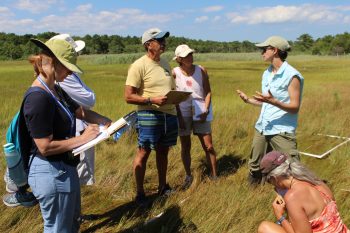 Workshop Description: We all live within a watershed and community collaboration is essential for healthy ecosystems. Participants in this Teachers on the Estuary (TOTE) workshop will explore coastal habitats, conduct field investigations, and explore tools that gamify cooperative decision-making. Reserve scientists will escort teachers to their long-term monitoring sites and experienced educators will demonstrate how to incorporate that local and national data into classrooms. Through cooperative gameplay of the Watershed Game: Classroom Version participants will put into practice plans, and policies to decrease water pollution and increase a community’s resilience to flooding while balancing financial resources. Teachers will take home resources to replicate the activities in their own classroom. Course content and activities will be aligned with Massachusetts state science and math frameworks and Next Generation Science Standards.
Workshop Audience: Designed for teachers of grades 6-12, but applicable to upper elementary and college.
Location: Waquoit Bay National Estuarine Research Reserve, 131 Waquoit Highway, Waquoit, MA 02536.
Cost and meals: This course is offered free of charge. Light breakfast, snacks, and lunch are provided.
Support: Each participant will receive equipment and other resources. Those who elect to present at the virtual session about how they have implemented, or plan to implement, the resources with their students are eligible for a $150 presentation honorarium.
Lodging: Dorm style lodging may be available at no cost for those participants living beyond commuting distance, but space is limited and reservations are required. If you need lodging, please contact Laurie Tompkins for options: laurie.tompkins@mass.gov.
Instructor: Sonia Ahrabi-Nejad, Education Coordinator, Waquoit Bay NERR Sonia.Ahrabi-Nejad@mass.gov
PDPs: Participants who complete all requirements will receive 16 PDPs.
Graduate Credit: The course is offered for 1 graduate credit. Graduate credit is optional and is available from Bridgewater State University for $75.00 per credit.
Workshop Goals
• Increase teachers’ understanding of estuary science and their ability to engage their students in the investigation of changes in their local environment using data obtained from the reserve’s monitoring programs and community conservation projects.
Workshop Objectives: Participants will be able to:
• Describe how human activities associated with various land uses within a watershed may pollute a coast with excess sediment, nitrogen or phosphorus and make it vulnerable to flood damage.
• Discover that communities must work together as a whole watershed to protect water quality and increase coastal resilience.
• Access and use NERRS/NOAA educational products with students.
• Teach basic estuarine concepts by guiding students in using field and laboratory research techniques analogous to those used at Research Reserves.
• Lead their students in experiential learning activities that improve their students’ abilities to become stewards of the environment.
• Meet Massachusetts Learning Standards and Next Generation Science Standards appropriate to the grade and subject they teach (see list of a few examples below).
• Give evidence to support the basic concepts in the Estuary Principles (see below).
Estuarine Principles
1. Estuaries are interconnected with the world ocean and with major systems and cycles on Earth.
2. Estuaries are dynamic ecosystems with tremendous variability within and between them in physical, chemical, and biological components.
3. Estuaries support an abundance of life, and a diversity of habitat types.
4. Ongoing research and monitoring is needed to increase our understanding of estuaries and to improve our ability to protect and sustain them.
5. Humans, even those living far from the coast, rely on goods and services supplied by estuaries
6. Human activities can impact estuaries by degrading water quality or altering habitats; therefore, we are responsible for making decisions to protect and maintain the health of estuaries.
Please click here to download complete flyer, PDP instructions and additional course information.
Questions? Contact Sonia Ahrahi-Nejad, Education Coordinator, Waquoit Bay Reserve.
Venue: Waquoit Bay National Estuarine Research Reserve
Venue Phone: 508.457.0495
Venue Website: https://waquoitbayreserve.org/
Address:There are no upcoming dates for this event.